
New technics:TU Delft Researchers Develop High-Efficiency Heterojunction Solar Cell with 23.4% Efficiency
Researchers at Delft University of Technology (TU Delft) in the Netherlands have recently made significant progress in heterojunction solar cell technology. By employing an innovative "top-down" processing method, they successfully designed a rear junction heterojunction solar cell (RJ-SHJ) with a localized front contact architecture, achieving a conversion efficiency of 23.4%. This breakthrough not only improves the cell’s fill factor (FF) but also significantly enhances its resistance to ultraviolet-induced degradation, paving the way for the commercialization of next-generation high-efficiency solar technologies.
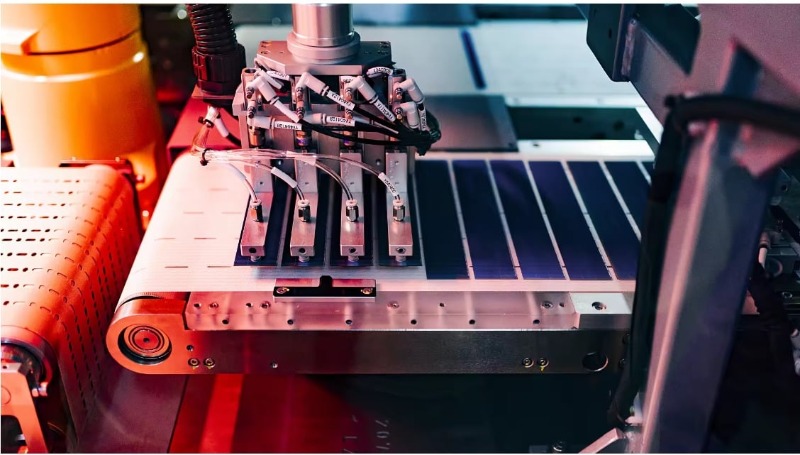
Image source: Media news_Photovoltaic cell production
Technical Breakthrough: Self-Aligned Localized Contact Architecture
The core innovation lies in the development of a self-aligned method to precisely position the cell’s front contact electrodes. Traditional heterojunction cells typically require a transparent conductive oxide (TCO) layer covering the entire front surface for charge transport, but this design can lead to optical absorption losses and increased resistance.
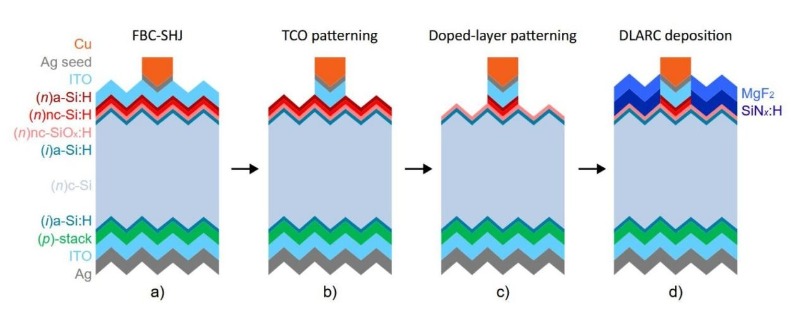
The technical structure provided by the research team
“Our approach uses localized etching to retain the front contact layer only in areas covered by the metal grid, while completely removing it elsewhere,” explained Dr. Sebastian Smits, the lead researcher, in an interview with pv magazine. This process leverages the metal grid as a mask to selectively etch away the TCO layer and n-doped layers in non-contact regions, avoiding damage to the cell’s mechanical stability.
Key Process: Nanocrystalline Silicon Oxide "Barrier" Layer
To achieve high-precision control over localized contacts, the team introduced an 8-nanometer-thick hydrogenated nanocrystalline silicon oxide (nc-SiOx:H) layer between the intrinsic layer (i-layer) and the contact stack. This ultrathin layer acts as a “barrier” during etching, protecting the underlying intrinsic layer from damage while minimizing resistive losses in the contact layer.
“The nc-SiOx:H layer maintains surface passivation (preventing carrier recombination) and avoids reductions in fill factor or open-circuit voltage caused by etching,” emphasized Smits. Additionally, the retained TCO layer in the window area continues to function as an anti-reflective coating (ARC), reducing optical losses caused by the refractive index mismatch between silicon and air.
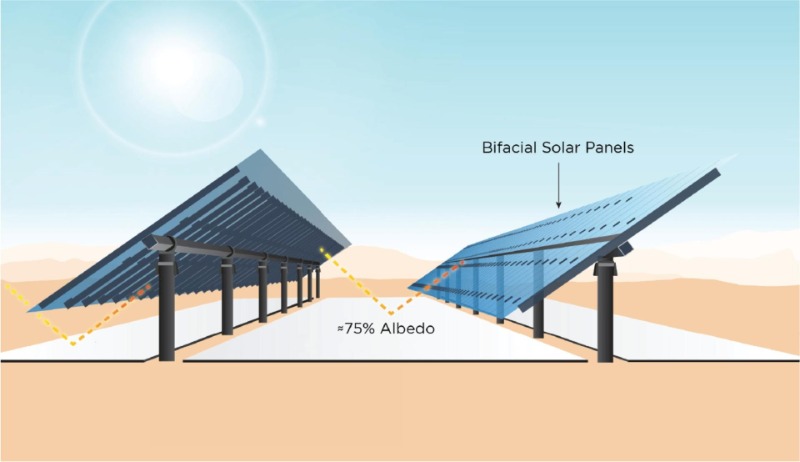
Image source: Media news_The power generation efficiency of bifacial photovoltaic modules is affected by refraction
Performance Advantages and Potential Applications
Enhanced Efficiency and Stability
The localized contact design significantly improves the fill factor and reduces UV-induced degradation rates, directly enhancing the cell’s long-term reliability in outdoor environments.
Process Compatibility
The technology is compatible with existing heterojunction production lines, requiring no complex masks or additional equipment—only an added etching step in standard workflows—thus lowering mass-production costs.
Versatile Applications
The architecture is particularly suited for bifacial modules or high-light-utilization scenarios, as its highly transparent window area maximizes absorption of rear-side incident light.
The research team plans to further optimize the material composition of the contact layers and etching processes, aiming to push cell efficiency beyond 24%. They are also exploring applications of this technology in perovskite/silicon tandem cells to surpass the efficiency limits of single-junction cells.
This achievement has been published in top international energy journals and has garnered significant industry attention. As the clean energy transition accelerates, such high-efficiency, low-cost solar technologies are expected to drive further reductions in photovoltaic costs within the next five years.
TU Delft’s research reaffirms that traditional silicon-based solar cells still hold vast potential for performance improvements through innovative structural and process design. This technology not only injects new momentum into the industrialization of heterojunction cells but also provides critical technical reserves for global carbon neutrality goals.

Image source: Media news_TU Delft clean-room
 Radiant Gathering in São Paulo | Sunpro Power Showcases at Intersolar South America 2026
  Re‑elected Consecutively! Sunpro Power Reappears on BNEF Tier 1 List for Q3
  Sunpro Power’s PV Modules Earn Authoritative Certifications From TÜV SÜD, Robust Quality Fuels Global Market Expansion
  Shine Bright in Munich! Sunpro Power Showcases High-Efficiency Modules at Intersolar Europe 2026
  TÜV SÜD and Sunpro Power Sign ESG Strategic Cooperation Agreement to Empower Green Industrial & R&D Upgrading
  Powerful Lineup Debuts in Shanghai! Sunpro Power’s High-Efficiency Modules Shine at SNEC 2026
  Sunpro Power Secures Spot Again on BNEF Tier 1 List for 2026 Q2
  Hardcore Lineup Lands in Manila! Sunpro Power High-Efficiency Modules Shine at Solar & Storage Live Philippines 2026
  Hardcore Certification! Sunpro Passes TÜV Thresher Test, Reliability Receives Endorsement
  Smart Energy in Vienna! SUNPRO POWER Presents High-Efficiency Modules at Solar Solutions 2026
  Green Energy Crosses Borders! SUNPRO POWER’s High-Efficiency Modules Shine at RE+ México 2026
  Hardcore Lineup Shines in Guangzhou! SUNPRO POWER’s High-Efficiency Modules Debut at the 139th Canton Fair
  Sunpro Earns Multiple ISO Certifications, Forging a Solid Foundation for Development with Rigorous Management
  Efficiency and Aesthetics in One: SUNPRO POWER's High-Efficiency Modules Shine at Key Energy 2026 Italy
  Major Certification! Multiple Sunpro TOPCon Modules Awarded France's PPE2 Carbon Footprint Certification, Unlocking the Green Pass to the French Market
  2026 Tier1 Q1 Ranking Announced | Sunpro Power Maintains Its Leading Position
  Kicking Off 2026 with a Grand Debut! Sunpro power Makes a Powerful Appearance at Intersolar Africa 2026, Illuminating Africa's Energy Future!
  Perovskite Solar Technology Achieves Major Breakthrough! Durability Challenge Conquered
  Poland's PV Target: 59.1GW by 2035, Emerging as a Key Driver of Europe's Energy Transition
  Sunpro Retains BloombergNEF Tier 1 PV Module Manufacturer Status for Q4 2025